 Daepak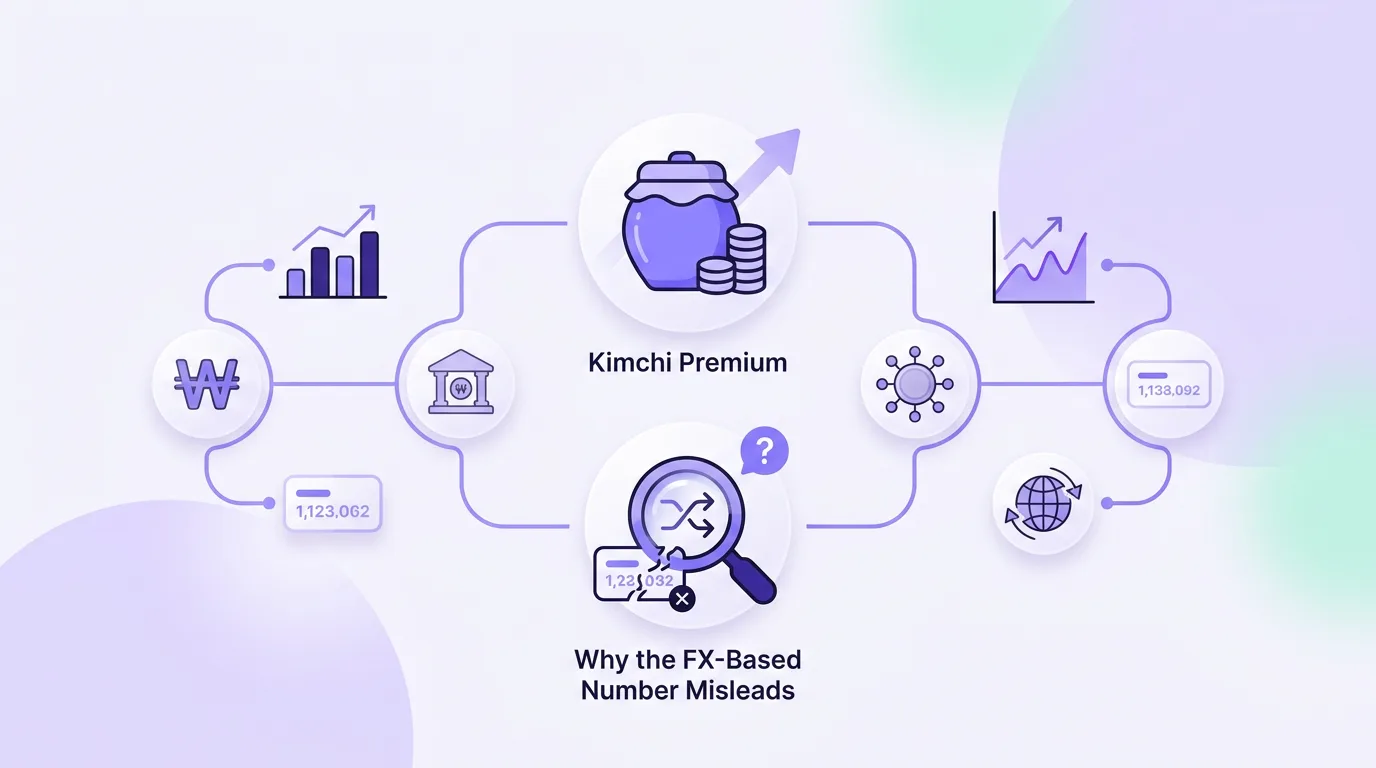
Korea's crypto market has a price tag of its own. Traders call it the kimchi premium (김치프리미엄). On 2026-09-14 it printed +0.72% on the FX basis and -0.07% on the Tether basis. Same market. Same day. Opposite signs.
That gap is the whole story.
What the number is supposed to mean
Bitcoin trades in won on Korean exchanges like Upbit. It trades in dollars almost everywhere else. Convert the Korean won price into dollars and compare. If Korea is higher, you have a premium.
In theory, arbitrage closes it. Buy abroad, sell in Korea, pocket the difference. In practice, that trade is hard here. FX rules and limits on foreign participation keep the doors narrow. So the gap can sit open for weeks.
Two ways to convert won into dollars
You need a conversion rate. Korea gives you two.
| Basis | What you divide by | What it captures |
|---|---|---|
| FX basis | The market USD/KRW rate | Won leg + asset leg |
| Tether basis | The won price of USDT on Korean exchanges | Asset leg only |
The FX basis is the headline number. The Tether basis strips out the currency distortion. Both get quoted in Seoul. They rarely agree.
September 14, 2026: a sign flip
On that day the FX-based premium was +0.72%. The Tether-based premium was -0.07%.
Read that again. The headline said Korea was expensive. The Tether-adjusted number said Korea was, if anything, marginally cheap. The two prints differ by roughly 0.8 percentage points. That is not noise. That is the won leg doing the work.
The read from that session was blunt: most of the markup came from the Tether premium, not from the coin.
The won leg: a surcharge on everything
Korean USDT trades away from the market FX rate. When it trades above, every coin on the exchange inherits the markup.
This is the key point. The won leg is not about Bitcoin. It is not about Ethereum. It applies equally to every coin quoted in won. If the won leg is +0.8%, a coin with zero global demand still shows a premium.
So when a big kimchi premium hits your feed, ask one question first. Is this coin wanted, or is the dollar simply expensive in Korea?
The asset leg: what is left for the coin
Subtract the won leg and you get the asset leg. This is the part that reflects real local demand for that specific token.
It can be positive. It can be negative. On 2026-09-14 it was slightly negative. Korean buyers were not paying up for the asset itself. They were paying up for dollars.
That distinction matters for anyone reading the number as a sentiment gauge.
Why the FX-based number misleads
The FX-based premium overstates coin demand. It also overstates arbitrage profit.
Say the headline reads +0.72%. A trader assumes they can capture that. They cannot. The won leg is baked into the USDT price they must use to move money. It is a cost, not a spread. What is left for the actual asset is the smaller number.
There is a second trap. When the premium shrinks, the Korean won price can fall even if the global price does not move. The coin did not get weaker. The local markup did. Traders who treated the premium as demand get hurt by exactly that.
What to check before acting on a print
Look at both legs. Overseas price first. Then the current premium level. Together they tell you whether you are buying the asset or buying the won.
Watch the FX rate too. The won has been trading in the mid-1,340s per dollar. A move there shifts the won leg with no change in coin demand. The overnight link between Seoul and US risk assets runs through that rate, which is worth reading alongside this breakdown of the KOSPI–Nasdaq channel.
Regulation moves the won leg as well. From January 1, 2027, Korea taxes annual crypto net gains above 2.5 million won at 22%. Holdings from before 2027 get a cost basis set at the higher of the actual purchase price and the December 31, 2026 market price. A Senate procedural vote on the CLARITY Act was scheduled for September 15, 2026.
Both change how won flows in and out. Neither changes what Bitcoin is worth in dollars.
For live tracking, the kimchi premium page keeps the won leg and asset leg separate instead of collapsing them into one figure, and Bitcoin's live price and AI score sit next to it. Bitcoin was quoted at 77,260.34 at the last snapshot, down 0.57% over 24 hours, with Ethereum at 2,482.71 and XRP at 1.401.
The short version
The kimchi premium is two numbers wearing one name. The won leg is a currency distortion that hits every coin. It is the coin's own story