 Daepak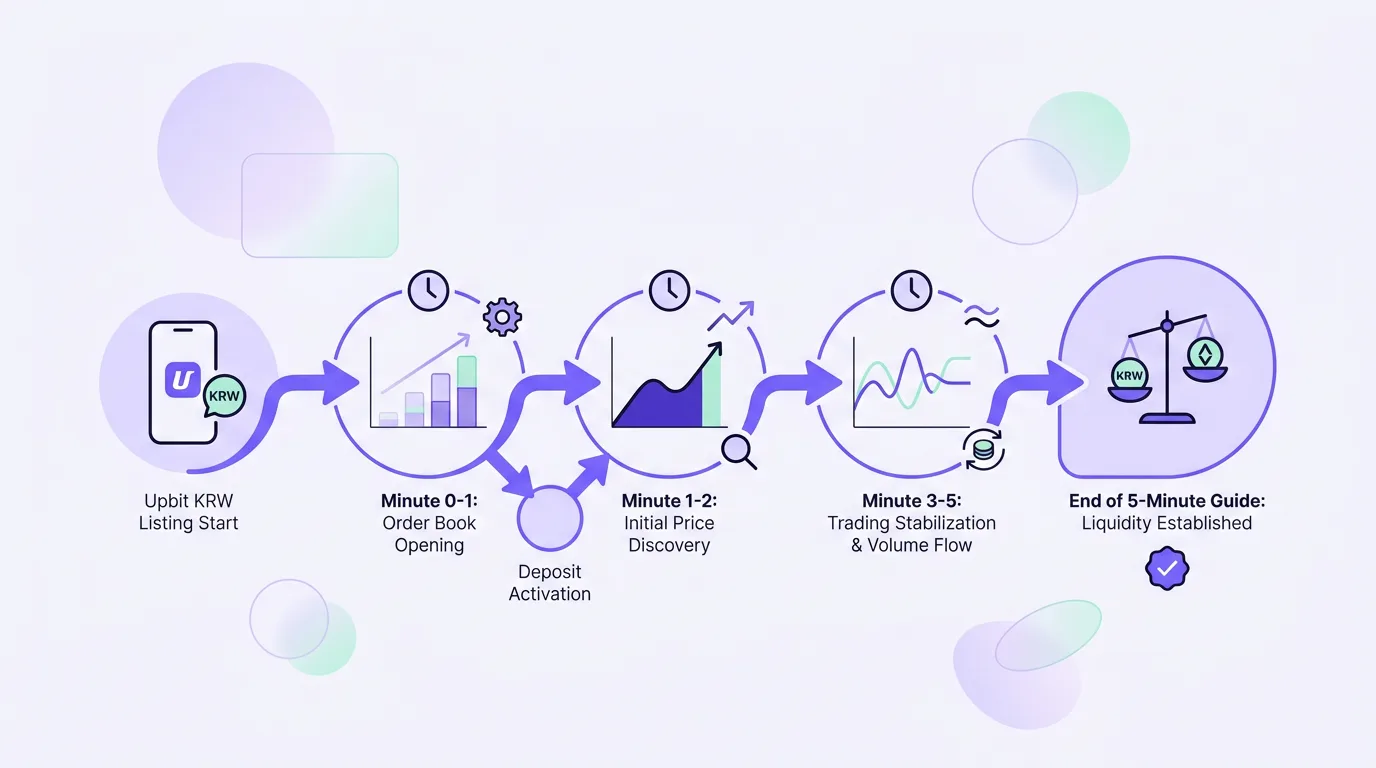
What a KRW listing actually is
On Upbit, Korea’s largest crypto exchange, a token can be listed against Korean won (KRW), Bitcoin (BTC), or Tether (USDT). A KRW listing is the most consequential for local price action. It gives Korean retail investors a direct fiat on-ramp, so they can buy the token with won without first converting to BTC or a stablecoin. That distinction matters because Korean retail flows are large, fast, and concentrated in the first hours after a listing goes live.
Upbit and Bithumb publish formal listing procedures on their Korean-language sites, and the structure is similar across Korea’s five major exchanges. But the market impact is not about the procedure; it is about what happens when a new won pair opens with almost no historical liquidity.
The pre-open setup
Before the first trade, Upbit typically announces the listing time and any deposit restrictions. For example, GRVT was listed against KRW, BTC, and USDT at 17:00 KST on August 5, 2026, with deposits supported only via the Ethereum network. Sometimes the schedule shifts: when Upbit added MORPHO and EUL KRW pairs, Euler’s KRW trading launch moved to 2:00 p.m. KST, two hours later than initially scheduled.
These details matter because they determine who can get tokens into the exchange before the open. If deposits are limited to one network or open late, the initial float on the KRW order book is even thinner, which amplifies the first-hour move.
The first minutes: a won-driven pump
When the KRW pair opens, the order book is usually shallow. There are few resting bids and asks, so even moderate Korean retail buying can move the price sharply. The pattern is repeatable: a burst of FOMO buying, a vertical candle, and a local top that often has little to do with the token’s global fundamentals.
Recent examples from 2026 show the scale. B3 Base Token surged 249% on its Upbit Korea KRW listing. Fluent pumped 177% on its Upbit KRW debut earlier in the year. ICP rallied 10% with $100 million added to market cap on its KRW listing. GRVT soared past 500 won after its Upbit listing. These moves are not global repricings; they are local liquidity events.
The driver is Korean retail FOMO. Korean investors are known for aggressive momentum chasing, and a new KRW listing is a visible, tradable event. Because the pair is quoted in won, there is no friction of converting to BTC or USDT first. The result is a concentrated burst of buying in the first minutes to hours.
The liquidity shock and reversal risk
The same thin order books that enable the pump also create the reversal. Once the initial buying slows, there may be few bids to absorb profit-taking. A single large sell order can trigger a cascade, and the price can give back a large portion of the initial gain in minutes.
This is the liquidity shock: a sudden imbalance between aggressive sellers and a shallow bid side. It is not a fundamental change; it is a structural feature of a new pair with no established market makers or historical depth. The token’s global price on other exchanges may barely move while the Upbit KRW price swings by double digits.
The gap between the Upbit KRW price and the global price is a form of the kimchi premium. The kimchi premium is the well-known phenomenon where Korean exchanges trade at a premium to global venues due to local demand and limited arbitrage. For new listings, that premium can be extreme in the first hours, then compress as arbitrageurs and liquidity providers step in. You can track the live kimchi premium on Daepak’s dedicated page.
What professionals watch in the first hours
Experienced traders do not chase the first candle. Instead, they monitor a short checklist:
- Listing time and delays — a delayed open often means more pent-up demand, but also more uncertainty.
- Deposit network and restrictions — if only one network is supported, the initial float is smaller and the pump can be sharper.
- Order book depth — how many won are resting within a few percent of the mid price. Thin books mean high volatility.
- Global price comparison — the same token on Binance, Coinbase, or a decentralized exchange. A large gap signals local premium, not global demand.
- Korean retail sentiment — search trends, community boards, and social media activity. FOMO is measurable before it shows up in price.
The key insight is that the first hours are a flow event, not a valuation event. The token’s technology, roadmap, or global adoption may be unchanged. The move is driven by the sudden availability of a won on-ramp and the behavior of Korean retail traders.
A 5-minute flow guide
If you want to understand a new Upbit KRW listing without getting caught in the noise, follow this sequence:
- Check the announcement — note the exact listing time, the pairs (KRW, BTC, USDT), and any deposit restrictions.
- **Watch the